


Fleet visibility is a safety issue, but for operators and aftermarket buyers it is also a recurring procurement cost. Bus and Truck Wiper blades are replaced in high volumes, and sourcing them directly from manufacturers can improve margins, tighten specification control, and reduce supply chain dependence. The opportunity is significant, but only when buyers understand minimum order quantities, fitment complexity, quality controls, freight timelines, and the technical demands of heavy-duty vehicles. This guide explains when factory-direct purchasing makes sense, what specifications to define before requesting quotes, and how to reduce sourcing risk while building a reliable wholesale supply program.
Why Source Bus and Truck Wiper Blades Directly
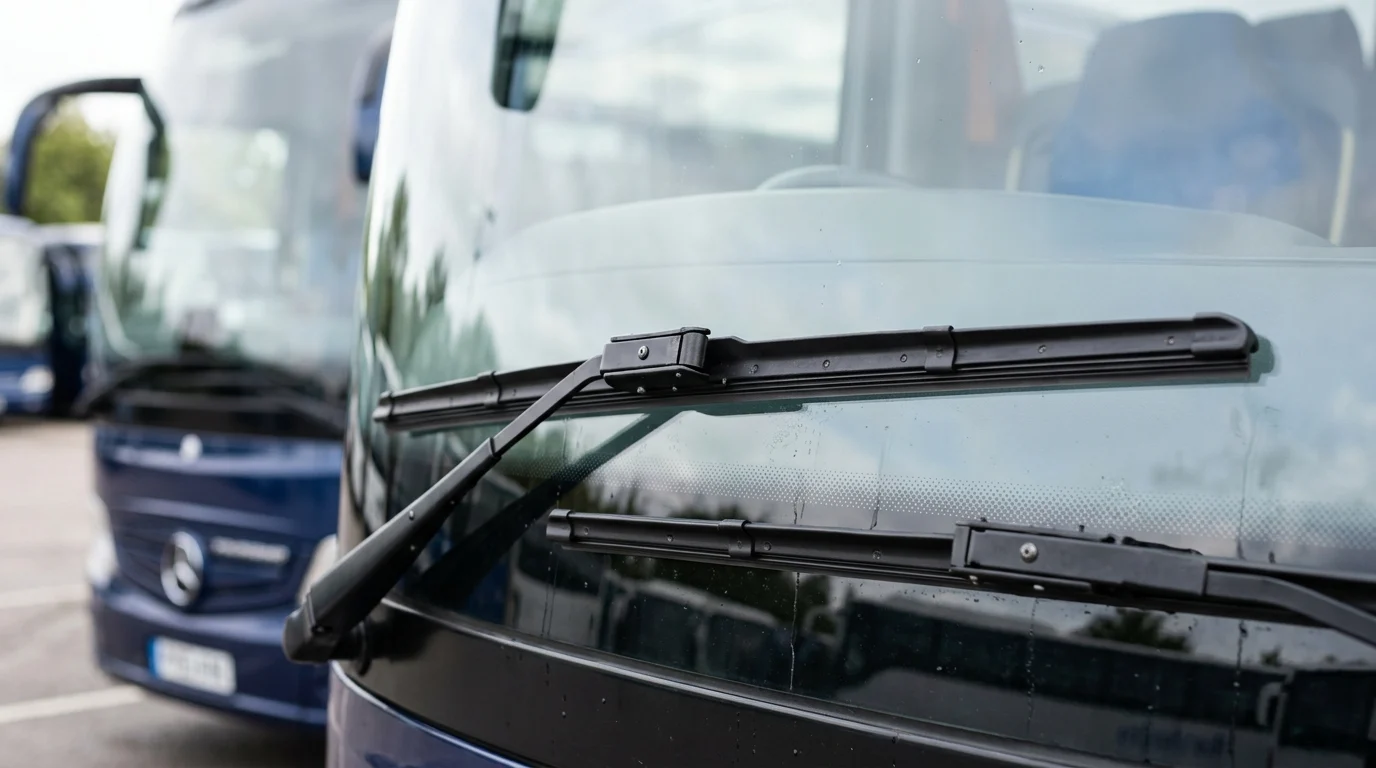
As procurement professionals managing commercial fleets or aftermarket distribution, we know that consumable parts like wiper blades represent a consistent, high-volume expense. Sourcing these components directly from overseas manufacturers rather than local distributors requires a strategic approach, but the financial and operational payoffs can be substantial.
Cost, Control, and Supply Advantages
By eliminating domestic distributors and regional wholesalers, we can typically secure a 30% to 40% reduction in unit costs. Sourcing Wholesale truck wiper blades directly allows us to control the exact bill of materials, ensuring the rubber compounds and steel frames meet our specific fleet requirements rather than settling for off-the-shelf compromises.
When Direct Factory Sourcing Makes Sense
Direct factory engagement is not the right strategy for every buyer. In my experience, this route makes commercial sense only when our annual purchasing volume exceeds 10,000 units, and we can comfortably meet Minimum Order Quantities (MOQs) of 2,000 to 3,000 pieces per shipment. If our demand falls below this threshold, the logistics overhead and customs clearance fees often outweigh the unit cost savings. Keep in mind that specific figures—such as MOQs, unit prices, test durations, and container capacities mentioned throughout this guide—are illustrative benchmarks that will vary by supplier, region, and exact specification.
Key Commercial Risks to Evaluate
Bypassing domestic suppliers introduces distinct commercial risks that we must actively underwrite. Ocean freight lead times from Asia to North America or Europe typically span 35 to 60 days, requiring us to maintain higher safety stock levels to avoid vehicle downtime. Furthermore, we must negotiate strict quality control agreements to ensure defect rates remain below the industry standard of 1%, as returning defective stock overseas is financially unviable.
How to Define the Right Product Specifications
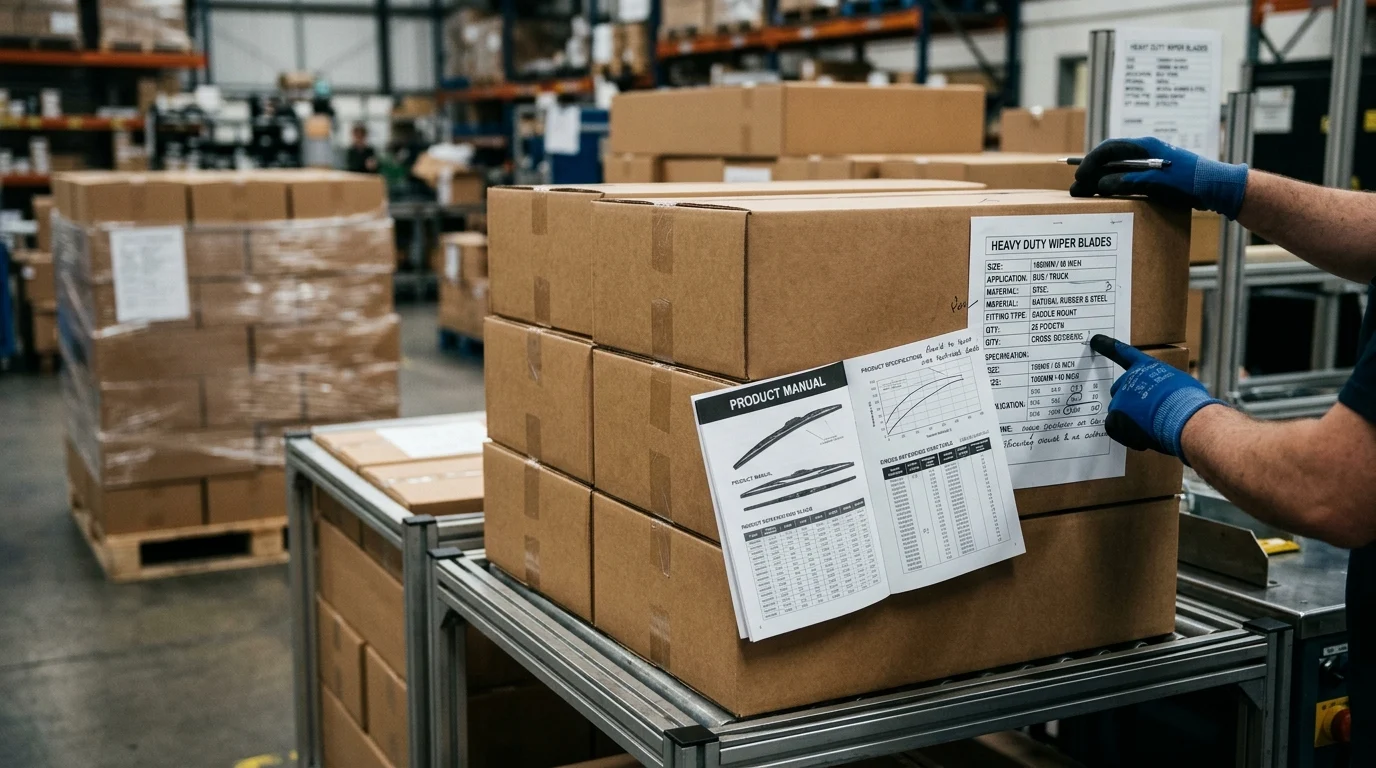
Commercial vehicles operate in punishing environments, meaning standard passenger car specifications will fail prematurely under the strain of continuous use. We must define rigorous technical parameters before approaching any factory with a request for quotation.
Heavy-Duty Wiper Blade Types to Compare
Heavy-duty applications generally require robust conventional frame blades, though some modern transit buses utilize flat (beam) blades for better aerodynamics. For conventional styles, we must specify a galvanized steel frame with a minimum thickness of 1.2mm to withstand high wind shear at highway speeds. The structural rivets must be stainless steel to prevent corrosion, which is a common failure point in cheaper alternatives.
Fitment, Length Range, and Adaptor Systems
Commercial windshields demand extended blade lengths, typically ranging from 24 inches (600mm) up to 40 inches (1000mm). The adaptor systems are also significantly larger than those on passenger vehicles. We must clearly specify saddle sizes, such as 12x4mm, 16.5x4mm, or heavy-duty wide hook sizes. Working with a specialized bus wiper blade manufacturer ensures access to these robust fitments rather than flimsy plastic clips. Because commercial vehicle fleets span decades of platforms, vehicle-specific fitment must always be validated against the exact vehicle model and year to prevent costly sourcing failures.
| Feature | Passenger Vehicle | Heavy-Duty Bus/Truck |
|---|---|---|
| Typical Length Range | 14" - 26" | 24" - 40" |
| Frame Material Thickness | 0.8mm - 1.0mm Steel | 1.2mm - 1.5mm Reinforced Steel |
| Common Adaptor Size | 9x3mm / 9x4mm Hook | 12x4mm / 16.5x4mm Saddle / Hook |
| Rubber Profile | Standard narrow | Heavy-duty wide profile |
Product Details to Include in Your RFQ
A comprehensive RFQ is our best defense against substandard products. I always mandate that the RFQ includes the specific rubber formulation—typically 100% natural rubber with a graphite or Teflon coating—and a required durability threshold of at least 500,000 continuous wipe cycles. We should also specify the operating temperature range, usually -40°C to +80°C, to ensure the rubber does not crack in winter or melt onto the glass in summer.
How to Compare Wiper Blade Manufacturers
The global market is flooded with trading companies posing as factories. To secure reliable, long-term production, we must systematically evaluate actual manufacturing capabilities and weed out the middlemen.
Factory Capabilities and Tooling Requirements
A legitimate factory will have in-house stamping machines for the steel frames, dedicated rubber extrusion lines, and injection molding equipment for the plastic adaptors. If we require a proprietary adaptor design for a specific fleet, we should expect to pay tooling costs ranging from $2,500 to $5,000. Factories that outsource their rubber mixing or frame stamping introduce supply chain vulnerabilities and quality inconsistencies that we must avoid.
Price, MOQ, Lead Time, and Quality Comparison
When evaluating potential partners for bulk commercial wiper blades, we must look beyond the initial quote. We need to compare suppliers across multiple dimensions to find the right balance of cost, speed, and reliability.
| Supplier Tier | Est. Unit Price (28" Frame) | Standard MOQ | Avg. Production Lead Time | Target Defect Rate |
|---|---|---|---|---|
| Tier 1 (Premium) | $3.50 - $4.80 | 3,000 pcs | 45-60 Days | < 0.5% |
| Tier 2 (Mid-Market) | $2.20 - $3.40 | 1,000 pcs | 30-45 Days | < 1.0% |
| Tier 3 (Budget) | $1.20 - $2.00 | 500 pcs | 20-30 Days | 2.0% - 3.0% |
How to Identify a True Manufacturer
To differentiate a true manufacturer from a trading company, I always request the supplier's ISO 9001 or IATF 16949 certification and verify the factory address listed on the document via third-party database audits. Furthermore, requesting a live video tour of the production line and reviewing their export records (Bill of Lading data) can confirm whether they actually manufacture heavy-duty commercial blades or simply source passenger car blades locally to flip.
How to Manage the Sourcing Process
Once we have shortlisted capable manufacturers, the sourcing process transitions into formal negotiation and validation. This phase dictates the long-term commercial viability of our supply chain.
Preparing an RFQ with Vehicle and Market Requirements
Our RFQ must be localized to the specific vehicle platforms our market demands, such as Volvo, Scania, or Freightliner commercial trucks. We should provide OEM part numbers or detailed 2D/3D CAD drawings where possible. When dealing with a dedicated Heavy-duty wiper supplier, providing target price benchmarks—for example, indicating a hard ceiling of $2.80 per unit for a 32-inch frame blade—helps quickly align expectations and weed out uncompetitive bidders.
Sample Testing and Quality Evaluation
Never authorize mass production without rigorous sample validation. In our procurement operations, we subject pre-production samples to a 120-hour salt spray test to verify the frame's anti-corrosion plating, and a 72-hour ozone exposure test to ensure the rubber won't prematurely degrade. Only after the samples pass these physical laboratory tests, alongside real-world fitment checks on the target commercial vehicles, do we proceed to mass production.
Negotiating Price, Tooling, Payment, and Delivery Terms
Effective negotiation goes well beyond the unit price. While we typically aim for standard international payment terms—such as a 30% T/T deposit with the 70% balance paid against the copy of the Bill of Lading (B/L)—this exposes buyers to shipping-document fraud on initial orders. For new suppliers, safer alternatives like a Letter of Credit (L/C), third-party escrow, or an inspection-paid balance are highly recommended until a track record exists.
Additionally, we must negotiate the amortization of any custom tooling costs, stipulating that the factory will fully rebate the $3,000 mold fee once our cumulative order volume reaches 50,000 units. Finally, negotiations must cover after-sales arrangements, including warranty claims handling, spare-part consistency across reorders, and clear clauses regarding tooling ownership.
Compliance, Logistics, and Final Supplier Selection
The final hurdle involves securing the logistics network and ensuring total compliance before the first container leaves the port of origin. Proper execution here prevents costly delays at customs.
Compliance Documents and Quality Certifications
Commercial vehicle parts often face strict regulatory scrutiny depending on the destination market. We must ensure the supplier provides valid quality management certificates. While IATF 16949:2016 is a strong OEM supply-chain expectation, it is not a legal import requirement, and many legitimate aftermarket manufacturers hold only ISO 9001. It is crucial to distinguish between customer-driven certification expectations and actual regulatory requirements. If we are importing truck windshield wiper wholesale orders into the European Union, we must also demand REACH and RoHS compliance declarations to guarantee the rubber compounds and plastics are free from restricted hazardous substances.
Incoterms, Packaging, and Container Loading
Choosing the right Incoterm drastically impacts our landed cost. We generally prefer FOB (Free On Board) terms, as it gives us control over the ocean freight via our nominated forwarder. For packaging, heavy-duty blades require sturdy blister packs or color boxes packed into double-corrugated master cartons to prevent crushing. A standard 20-foot shipping container can typically hold between 30,000 and 35,000 commercial wiper blades, depending on the length mix and outer carton dimensions.
Final Supplier Scorecard Before Ordering
Before issuing the final Purchase Order, we compile a supplier scorecard to make an objective decision. We weight quality audit results and sample testing at 40%, pricing competitiveness at 30%, communication and lead time at 20%, and financial stability at 10%. Any manufacturer scoring below 85 out of 100 on our matrix is restricted to a trial order of no more than 1,500 units, which effectively mitigates our risk while we build a track record of reliability.
Key Takeaways
- Consider direct manufacturer sourcing only if your annual demand is around 10,000 units or more and you can meet shipment MOQs of 2,000 to 3,000 pieces.
- Use direct sourcing to target 30% to 40% lower unit costs, but calculate freight, customs, quality control, and inventory carrying costs before committing.
- Specify heavy-duty construction details such as 1.2mm galvanized steel frames and stainless steel rivets to reduce premature failure in commercial use.
- Validate blade length, adaptor size, vehicle model, and model year before placing bulk orders to avoid expensive fitment mistakes.
- Plan inventory around 35- to 60-day ocean freight lead times and maintain safety stock so wiper blade shortages do not ground vehicles.
- Set clear quality agreements with the factory and aim to keep defect rates below 1% because returning defective stock overseas is rarely economical.
Frequently Asked Questions
When does direct factory sourcing make financial sense?
It usually makes sense when annual demand exceeds about 10,000 units and each shipment can meet MOQs of roughly 2,000 to 3,000 pieces.
How much can buyers save by purchasing directly from manufacturers?
Buyers may reduce unit costs by about 30% to 40% by bypassing domestic distributors, depending on specifications, order volume, freight, and customs costs.
What specifications matter most for bus and truck wiper blades?
Key specifications include blade length, adaptor type, galvanized steel frame thickness, rivet material, rubber compound, and verified fitment by vehicle model and year.
What blade lengths are common for commercial vehicles?
Bus and truck wiper blades commonly range from 24 inches (600mm) to 40 inches (1000mm), depending on windshield size and vehicle platform.
Why is fitment validation important before placing a bulk order?
Commercial fleets often include multiple vehicle generations, so adaptor sizes such as 12x4mm, 16.5x4mm, or wide hooks must be checked against exact models.