


A low-cost Wiper Blade can become a high-cost failure point when a bus or truck loses visibility in rain, snow, road spray, or high-speed crosswinds. For commercial fleets, the decision between traditional metal frame blades and modern frameless designs is not just a parts-bin preference; it affects driver safety, regulatory confidence, service uptime, and total cost of ownership. This breakdown examines how each architecture distributes pressure, handles curved glass, resists wind lift, and performs under demanding duty cycles. By comparing the practical strengths of frame, frameless, and hybrid options, fleet buyers can make a more defensible specification choice.

Why Bus and Truck Wiper Blades Matter
In our experience analyzing commercial fleet operations, we frequently see procurement teams overlook the strategic value of windshield Wiper Blades. While they represent a minor fraction of a heavy-duty vehicle's total maintenance budget, their failure can ground a commercial asset just as effectively as a major powertrain fault. For buses and trucks operating under stringent delivery schedules or passenger transport mandates, a compromised field of vision directly translates to liability and lost revenue.
To optimize total cost of ownership (TCO) and maintain rigorous safety standards, we must evaluate wiper blades not as generic consumables, but as engineered safety components. The choice between traditional and modern blade architectures dictates how well a fleet withstands extreme weather, chemical road treatments, and the aerodynamic forces of highway speeds.
Frame, Frameless, and Hybrid Blade Types
The commercial market is primarily divided into three architectural designs: traditional frame, frameless (or beam), and Hybrid Blades. Traditional frame blades utilize a metal superstructure with a series of linkages and pivots to distribute pressure across the rubber squeegee. These have been the industry standard for decades, andMetal frame bus wipers remain highly prevalent due to their robust construction and lower initial price point.
Conversely, Frameless truck wiper blades discard the external superstructure. Instead, they rely on a pre-tensioned internal steel spring embedded directly within the rubber or silicone housing. Hybrid blades attempt to merge these philosophies, encasing a traditional frame within an aerodynamic plastic shell to reduce wind lift while maintaining the structural rigidity of a metal frame.
Impact on Visibility, Safety, and Uptime
The direct correlation between wiper performance and fleet uptime cannot be overstated. According to commercial transport metrics, an unscheduled maintenance event due to visibility non-compliance can cost a fleet anywhere from $120 to $180 per hour in unexpected downtime, excluding potential fines. Furthermore, commercial vehicles must comply with strict Federal Motor Vehicle Safety Standards (such as FMVSS 104 in the US), which mandate specific wiped area percentages.
A blade that chatters, streaks, or fails to conform to the windshield curvature leaves hazardous blind spots. For transit buses navigating dense urban environments or Class 8 trucks managing complex highway maneuvers, maintaining 100% of the designed visibility arc is critical for collision avoidance and operator fatigue reduction.
Frame vs Frameless Wiper Blades
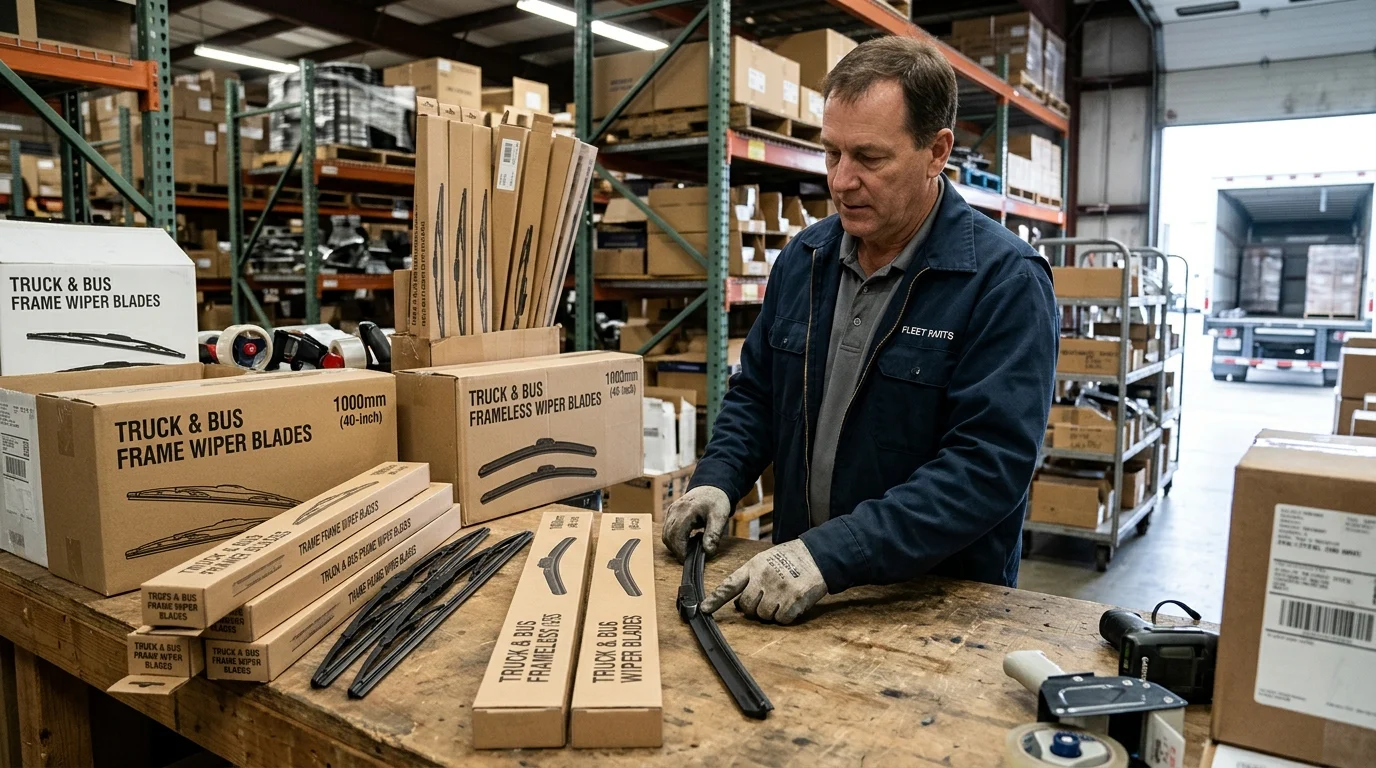
When we evaluate the engineering differences between frame and frameless architectures, the primary battleground is how effectively each design transfers the wiper arm's downward force to the glass. This mechanical transfer dictates wipe quality, resistance to environmental degradation, and ultimately, the replacement cycle frequency.
Pressure Distribution and Wipe Consistency
Traditional frame blades rely on a rigid central bridge that branches out into secondary and tertiary yokes. This creates a finite number of pressure points—typically 6 to 8 on heavy-duty commercial blades. While effective on flat glass, this design can lead to uneven pressure distribution on modern, highly curved bus windshields, resulting in streaking between the pressure nodes.
Frameless blades solve this by utilizing a continuous, pre-tensioned steel spline. This internal spring conforms dynamically to the windshield's exact curvature, creating an infinite number of pressure points along the entire length of the squeegee. The result is a highly consistent, uniform wipe that virtually eliminates the microscopic gaps where water and debris typically bypass the blade.
Durability and Rubber Compound Quality
Durability in commercial applications is largely a function of the rubber compound and the blade's structural integrity. Standard frame blades often use natural rubber, which performs well in temperate climates but degrades rapidly when exposed to UV radiation, ozone, and harsh road salts. Furthermore, the exposed metal pivots of a frame blade are highly susceptible to corrosion and mechanical binding.
Modern Heavy-duty beam wiper blades typically utilize advanced synthetic compounds, such as chloroprene or silicone blends, coated with graphite or Teflon. These synthetic materials can withstand up to 1.5 million wipe cycles in laboratory testing, compared to the 500,000-cycle average of standard natural rubber. The enclosed nature of the frameless design also protects the internal tension spring from the elements, eliminating pivot corrosion entirely.
Fitment, Maintenance, and Cost
From a procurement standpoint, the initial cost discrepancy is notable. A high-quality commercial frame blade may cost between $12 and $18 per unit, whereas a comparable frameless blade typically ranges from $22 to $35. However, maintenance labor and replacement frequency must factor into the TCO calculation.
Because frameless blades resist ice buildup and UV degradation more effectively, fleets often extend their replacement intervals from 6 months to 12 months. This 50% reduction in replacement frequency, combined with fewer driver complaints and expedited installation times, frequently offsets the higher initial purchase price.
| Feature | Traditional Frame Blades | Frameless (Beam) Blades |
|---|---|---|
| Pressure Distribution | 6-8 discrete points | Continuous / Infinite |
| Aerodynamic Lift | High at speeds >55 mph | Minimal due to integrated spoiler |
| Winter Performance | Poor (joints freeze/pack with ice) | Excellent (no exposed joints) |
| Average Lifespan | 500,000 wipe cycles | 1,000,000+ wipe cycles |
| Upfront Cost (Approx.) | $12 - $18 per unit | $22 - $35 per unit |
Operating Conditions That Drive Blade Choice
We cannot recommend a one-size-fits-all solution for commercial wiper blades because operational environments vary drastically. The physical forces acting on a long-haul truck traversing the Rocky Mountains are entirely different from those experienced by a low-speed municipal transit bus. Aligning the blade architecture with the vehicle's primary operating profile is essential for maximizing performance.
Highway, Urban, and Stop-and-Go Use
For Class 8 trucks operating primarily on highways, aerodynamic wind lift is a major factor. At speeds exceeding 65 mph (105 km/h), the airflow over the vehicle's cab creates an updraft that can pull traditional frame blades away from the glass, causing severe streaking. Frameless blades feature an integrated aerodynamic spoiler that utilizes this wind force to press the blade harder against the windshield, maintaining optimal contact.
Conversely, urban transit buses and sanitation trucks operate in stop-and-go environments where wind lift is negligible. In these low-speed, high-debris applications, heavy-duty frame blades often provide sufficient performance, provided the windshield is relatively flat and the wiping motor provides adequate torque.
Weather, Road Contamination, and Windshield Curvature
Weather conditions are perhaps the most critical variable. In regions experiencing heavy snow and sub-zero temperatures (dropping below -20°C), traditional frame blades are a liability. Snow and ice pack into the exposed metal yokes, freezing the joints and rendering the blade inflexible. Frameless blades, lacking an external skeleton, are virtually impervious to this type of ice packing.
Additionally, the curvature of the windshield dictates blade choice. Modern motorcoaches and aerodynamic truck cabs feature highly contoured glass. A rigid metal frame blade measuring 32 to 40 inches in length struggles to conform to these deep curves, often leaving the outer edges of the glass unwiped. The continuous tension of a frameless blade is required to wrap around these aggressive contours.
When to Choose Frame, Frameless, or Hybrid Blades
We advise fleets operating in mixed climates or long-haul routes to standardize on frameless blades to mitigate the risks of extreme weather and high-speed wind lift. The predictable performance across diverse environments justifies the investment.
For localized fleets operating in dry, temperate climates with low-speed routes—such as urban delivery step-vans or municipal school buses—traditional frame blades remain a fiscally responsible choice. Hybrid blades can serve as an effective middle ground for regional fleets that want aerodynamic benefits without fully transitioning to beam technology.
How to Specify, Source, and Validate Wiper Blades
Procuring commercial wiper blades at scale requires a rigorous validation process. We must move beyond simply matching lengths and instead evaluate the technical specifications, supplier capabilities, and real-world performance of the components before committing to a fleet-wide rollout.
Key Technical Specifications for Heavy-Duty Vehicles
Heavy-duty vehicles utilize specialized wiper arms that differ significantly from passenger cars. Commercial blades typically range from 24 to 40 inches (600mm to 1000mm) and require heavy-duty saddle attachments. Common commercial specifications include 12x4mm, 16x4mm, or 22x6mm hook or saddle mounts.
When drafting procurement specs, ensure the blade's internal tension spring is calibrated for heavy-duty arm pressure. A commercial wiper arm exerts between 1,200 and 1,800 grams of downward force, which will rapidly crush the lightweight springs used in passenger-grade frameless blades.
Supplier Evaluation and Fitment Coverage
Partnering with a reputable Commercial wiper blade manufacturer is critical for ensuring supply chain stability and product consistency. We evaluate suppliers based on their quality management systems, specifically looking for ISO 9001 or IATF 16949 certifications, which indicate stringent manufacturing controls.
When sourcing Bulk truck wiper blades, pay close attention to Minimum Order Quantities (MOQs) and defect rates. A reliable supplier should offer MOQs that align with your maintenance cycles (e.g., 500 to 1,000 units per SKU) and guarantee a defect rate of less than 0.2%. Furthermore, the supplier must provide comprehensive fitment catalogs to ensure seamless integration across mixed-asset fleets.
Field Testing Before Fleet Standardization
Before standardizing a new wiper blade specification, we strongly recommend a structured field test. Select a pilot group of 10 to 20 vehicles that represent your fleet's most demanding routes and environments. Install the prospective blades and monitor their performance over a 3- to 6-month period.
During this trial, maintenance managers should track driver feedback regarding visibility, monitor the degradation of the rubber edge, and calculate the exact cost-per-mile of the wiper system. This empirical data will validate the manufacturer's claims and prevent costly procurement errors.
Final Selection Framework
Ultimately, the transition from legacy wiper technologies to advanced architectures must be justified by a clear return on investment. By systematically evaluating the variables we have discussed—aerodynamics, climate, windshield geometry, and lifecycle costs—fleet managers can construct a definitive selection framework.
Decision Matrix for Performance and Cost
To simplify the procurement decision, we utilize a performance and cost matrix. This matrix weighs the upfront capital expenditure against the projected operational savings derived from reduced maintenance labor and extended replacement intervals.
Fleets that successfully migrate to optimized blade architectures routinely report a 15% to 20% reduction in their annualized wiper TCO, alongside unquantifiable but critical improvements in driver satisfaction and safety compliance.
| Operational Scenario | Primary Challenge | Recommended Blade Architecture | Expected ROI / Benefit |
|---|---|---|---|
| Long-Haul Highway | Wind lift, varied weather | Frameless (Beam) | High; eliminates high-speed streaking |
| Northern Climates | Ice packing, freezing joints | Frameless (Beam) | High; 50% fewer winter replacements |
| Urban Transit | Flat glass, low speeds | Traditional Frame | Moderate; lowest upfront cost |
| Mixed Regional | Moderate speeds, varying rain | Hybrid | Moderate; balances aero and cost |
Choosing the Best Blade Type for Your Fleet
Choosing the best blade type requires an honest assessment of your fleet's operational realities. If your vehicles operate at high speeds, face severe winter weather, or feature highly curved windshields, the premium paid for frameless technology is an investment in safety and uptime that will quickly pay dividends.
Conversely, if your fleet consists of older assets with flat windshields operating in mild, low-speed environments, traditional frame blades remain a structurally sound and economically viable option. By aligning your procurement strategy with these engineering realities, you ensure that your drivers maintain the critical visibility required to operate safely and efficiently.
Key Takeaways
- Treat bus and truck wiper blades as safety-critical components, because poor visibility can ground a vehicle as effectively as a major mechanical fault.
- Choose metal frame blades when initial cost, proven durability, and compatibility with flatter commercial windshields are the main procurement priorities.
- Specify frameless or beam-style blades for highly curved windshields or highway-heavy routes where continuous pressure and reduced wind lift are important.
- Factor downtime into purchasing decisions, since an unscheduled visibility-related maintenance event can cost about $120 to $180 per hour.
- Verify that replacement blades support required wiped-area performance, especially for fleets operating under standards such as FMVSS 104.
- Standardize blade selection by vehicle type, route conditions, and windshield geometry to improve wipe consistency and reduce replacement-cycle surprises.
Frequently Asked Questions
What is the main difference between frame and frameless bus and truck wiper blades?
Frame blades use a metal superstructure with pivot points to press the rubber against the glass. Frameless, or beam, blades use an internal spring structure to apply more continuous pressure, which can improve contact on curved commercial windshields.
Are metal frame bus wipers still a good choice for fleets?
Yes. Metal frame bus wipers remain popular because they are durable, cost-effective, and familiar to maintenance teams. They are especially suitable where windshield curvature is moderate and replacement cost control is a priority.
When should a fleet consider frameless truck wiper blades?
Fleets should consider frameless truck wiper blades when vehicles operate at highway speeds, face frequent rain or snow, or use highly curved windshields. Their beam-style design can reduce wind lift and improve pressure consistency.
How can poor wiper performance affect fleet uptime?
A failed or streaking wiper can create a visibility compliance issue and ground a vehicle. The article notes that unscheduled downtime may cost commercial fleets about $120 to $180 per hour, before fines or service delays.
Do commercial wiper blades affect safety compliance?
Yes. Bus and truck wipers help maintain the required wiped area and driver visibility. In the U.S., standards such as FMVSS 104 make windshield clearing performance a compliance and safety concern, not just a maintenance detail.